
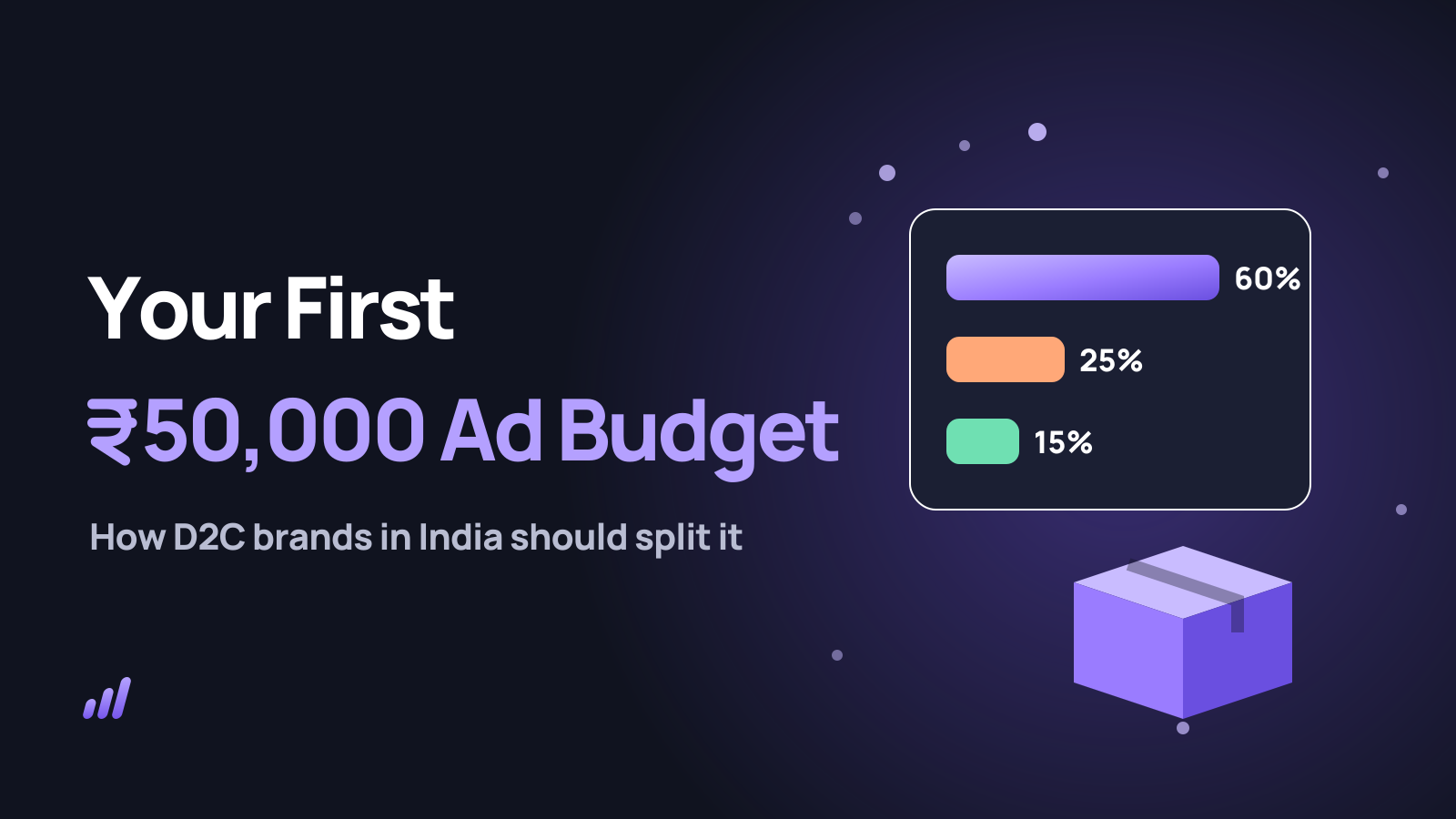
The simplest effective way for a new D2C or ecommerce brand in India to spend its first ₹50,000 on Meta ads is to split it into three parts: about 60% for one main prospecting campaign, 25% for testing new creatives, and 15% for retargeting people who already visited your store. Before spending a rupee, set up proper tracking and work out your break-even numbers. This guide shows exactly how, with a worked example, so you can see how much Facebook ads cost in India at this level and set a realistic Facebook ads budget for your small business.
By the GetToMarketing team, a Meta Ads agency in Zirakpur serving Chandigarh, Mohali, Panchkula and businesses across India. Last updated October 2026.
Quick answer
- Daily budget
- About ₹1,650 a day for 30 days
- Split
- 60% prospecting · 25% creative testing · 15% retargeting
- Must have first
- Meta Pixel + Conversions API tracking purchases
- Judge results by
- Cost per purchase vs your break-even CPA
Before you spend: three things to get right
1. Tracking
Install the Meta Pixel and set up the Conversions API (most Shopify, WooCommerce and other store platforms have an official Meta integration that does both). Check in Events Manager that ViewContent, AddToCart, InitiateCheckout and Purchase are firing with the correct value and currency. Without this, Meta cannot learn who buys, and you cannot tell which ads make money.
2. Your break-even numbers
Work out what you can afford to pay for one order before you lose money. A worked example:
| Item | Example value |
|---|---|
| Average order value (AOV) | ₹1,200 |
| Product cost, packaging, shipping, payment fees | ₹600 |
| Gross profit per order | ₹600 |
| Break-even cost per purchase (CPA) | ₹600 |
| Break-even ROAS | ₹1,200 ÷ ₹600 = 2.0 |
If you sell with cash on delivery, remember that some COD orders will be returned (RTO). If one in five COD orders comes back, your real cost per delivered order is noticeably higher than the cost per purchase Meta reports.
3. A store that converts
Ads send people to your store; the store has to close the sale. Check that product pages load quickly on mobile, show clear photos, price, delivery time and return policy, and that checkout supports UPI and cards. Fix these first; they make every rupee of ad spend work harder.
The ₹50,000 structure, explained
| Campaign | Share | Budget (30 days) | Purpose |
|---|---|---|---|
| Main prospecting (Advantage+ sales campaign or a broad sales campaign) | 60% | ₹30,000 (about ₹1,000/day) | Find new buyers, optimised for purchases |
| Creative testing | 25% | ₹12,500 (about ₹400/day) | Test new hooks, videos and offers to find winners |
| Retargeting | 15% | ₹7,500 (about ₹250/day) | Bring back visitors, cart abandoners and engaged viewers |
Why only three campaigns?
Meta’s delivery system learns from conversions. As a rough guide, an ad set needs around 50 optimisation events a week to exit the learning phase. At ₹1,650 a day and a cost per purchase of ₹500–800, you will get roughly 2–3 purchases a day. That is far below what each campaign would need if you split your budget across ten campaigns, so fewer campaigns with more budget each learn faster and perform better.
Campaign 1: Main prospecting (60%)
- Objective: Sales, optimised for Purchase.
- Audience: broad (country or the states you ship to fastest), letting Advantage+ audience find buyers. Exclude recent purchasers.
- Ads: your 3–5 best creatives. Mix short videos (UGC-style unboxing, founder story, product demo) with carousel or catalogue ads.
- Leave it alone for at least 5–7 days before making big changes. Constant edits restart learning.
Campaign 2: Creative testing (25%)
Creative is the biggest lever you control on Meta today. Use this campaign to test one new idea at a time: a different hook in the first three seconds, a different benefit, a creator video versus a studio shot, an offer versus no offer. When a new ad clearly beats your current ones on cost per purchase, move it into the main campaign.
Campaign 3: Retargeting (15%)
- Audience: website visitors and add-to-carts from the last 7–30 days, plus people who watched 50% of your videos or engaged with your Instagram.
- Ads: reviews, answers to common objections (size, quality, delivery time, returns), and a reason to buy now such as free shipping above a cart value.
- Keep frequency in check. If people see the same ad more than a few times a week, refresh it.
Week-by-week plan for the first month
| Week | What to do |
|---|---|
| Week 1 | Launch all three campaigns. Check events fire correctly. Don’t judge results yet. |
| Week 2 | Pause ads with clearly high cost per purchase and low click-through. Add 2–3 new test creatives. |
| Week 3 | Move winning test ads into the main campaign. If cost per purchase is below break-even, raise the main budget by about 15–20%. |
| Week 4 | Review delivered orders and RTO, not just purchases. Plan next month’s budget from real profit. |
Which numbers to watch
| Metric | Why it matters | Rough signal |
|---|---|---|
| Cost per purchase (CPA) | Your main profit check | Below your break-even CPA |
| ROAS | Revenue per rupee spent | Above your break-even ROAS |
| Click-through rate (link) | Does the ad stop the scroll? | Low CTR usually means the hook or visual needs work |
| Add-to-cart to purchase rate | Is the store or checkout leaking? | Many carts but few orders means fix price, shipping or checkout |
| RTO and return rate | Real profit for COD orders | Track by campaign if possible |
Common mistakes with a first ₹50,000
- Boosting Instagram posts instead of running proper sales campaigns.
- Optimising for link clicks or landing page views instead of purchases.
- Spreading the budget across too many campaigns and audiences.
- Judging results after two or three days.
- Ignoring RTO and returns, so a “good ROAS” hides a loss.
Frequently asked questions
How much should a D2C brand spend on Meta ads per month?
Many new Indian D2C brands start with around ₹30,000–1,00,000 a month. ₹50,000 (about ₹1,650 a day) is enough to run one main campaign, test creatives and retarget visitors, as long as tracking is set up first.
How should I split my Meta ads budget?
A simple split for a new store is about 60% on one main prospecting campaign, 25% on testing new creatives and 15% on retargeting visitors and cart abandoners.
What is a good ROAS for ecommerce in India?
There is no universal number. A good ROAS is one above your break-even ROAS, which you calculate by dividing your average order value by your profit per order before ad costs.
Should I use Advantage+ sales campaigns?
For most small D2C brands with working purchase tracking, an Advantage+ or broad sales campaign is a good main campaign because it combines audiences and placements and learns quickly. Keep a separate campaign to test new creatives.
Do I need the Conversions API?
Yes, it is strongly recommended. The Conversions API sends purchase events from your server, which makes tracking more reliable than the browser Pixel alone, especially with ad blockers and privacy settings.
Is GST charged on Meta ads in India?
Yes, Meta ad spend for Indian advertisers attracts 18% GST. How it appears depends on your billing setup and GST registration, so confirm the treatment with your accountant.
What is a good starting budget for Facebook ads?
For a new Indian D2C or ecommerce brand, about ₹1,000–2,000 a day (₹30,000–60,000 a month) is a practical starting Facebook ads budget, as long as purchase tracking works. Much less than that makes it hard for Meta’s delivery system to learn which people buy.
Want us to set this up for you?
GetToMarketing helps D2C and ecommerce brands across India set up tracking, structure their first campaigns and scale what works. Tell us your product, margins and goals, and we will suggest a budget plan.
6 thoughts on “How D2C and Ecommerce Brands in India Should Structure Their First ₹50,000 of Meta Ad Spend”