
Quick answer
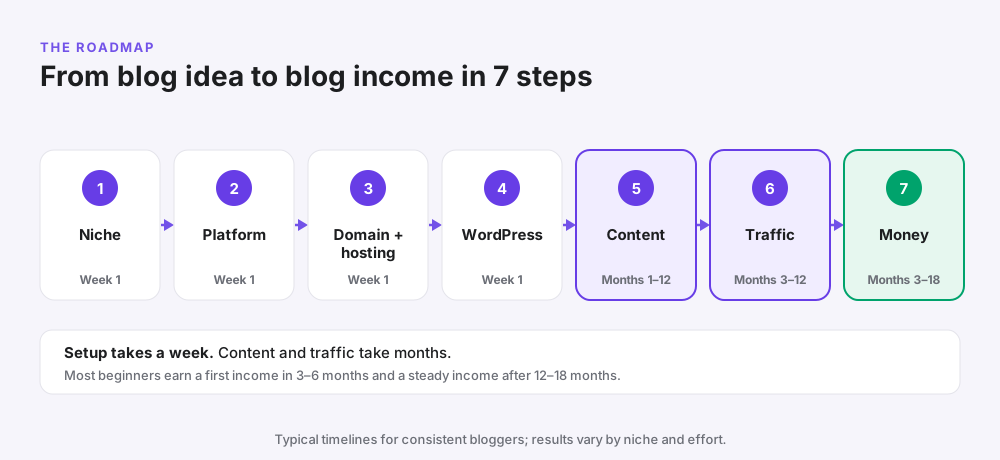
To start a blog and make money: choose a niche where people search for answers and advertisers pay, set up a self-hosted WordPress blog (about ₹176 a month with Hostinger Premium), publish 30–50 helpful posts that target low-competition keywords, then add income streams in this order: affiliate links and an email list first, display ads next, and finally your own products or services. Most beginners earn their first rupee in 3–6 months and a steady income after 12–18 months of consistent work.
Blogging for money at a glance (October 2026)
- Startup cost
- From ₹0 (free platform) · ≈ ₹176/month recommended
- Best platform for money
- Self-hosted WordPress
- Posts before real traffic
- Usually 30–50 quality posts
- Time to first income
- 3–6 months (typical)
- Time to steady income
- 12–18 months (typical)
- Best first income stream
- Affiliate marketing
Disclosure: some links in this guide are affiliate links. If you buy through them, we may earn a commission at no extra cost to you. Prices and programme rules were checked in October 2026 and can change.
In this guide:
- Quick answer
- What a money-making blog really is
- How bloggers make money (7 ways)
- Step 1: Choose a profitable niche
- Step 2: Pick a blogging platform
- Step 3: Get a domain and hosting
- Step 4: Set up WordPress
- Step 5: Write posts people search for
- Step 6: Get your first visitors
- Step 7: Start making money
- How much can you earn? (Real maths)
- Your first 90 days plan
- Common mistakes
- FAQs
Every month, thousands of people in India search for how to start a blog and make money. Most of them start excited, publish five posts, see zero visitors and quietly give up.
The problem is rarely effort. It is that most guides skip the parts that decide whether a blog earns: picking a niche with buyers, writing posts people actually search for, and adding income streams at the right time.
This guide walks you through the whole process in seven steps, with real costs in rupees, honest timelines and simple maths that shows how traffic turns into income. No coding, no hype, and no “₹1 lakh in 30 days” promises.
What is a money-making blog?
A money-making blog is a website that publishes helpful articles on one topic and earns from the visitors those articles attract. The articles bring in readers from Google; the income comes from ads, affiliate commissions, sponsorships, or your own products and services.
Think of each post as a small shop on a busy road. One shop earns very little, but 100 shops that each get a few visitors a day add up to a real business. That is why consistency matters more than any single “viral” post.
Is blogging still profitable in 2026?
Yes, but the rules have changed. Google now shows AI answers at the top of many results, so short, generic posts get fewer clicks. Blogs that win today share first-hand experience, real numbers, comparisons and step-by-step help that an AI summary can’t replace.
| Blogging in the past | Blogging in 2026 |
|---|---|
| Short 500-word posts could rank | Depth, experience and proof are needed |
| Display ads were the main income | Affiliate, email and products earn more |
| Broad “lifestyle” blogs worked | Focused niches win |
| Google was the only traffic source | Google + Pinterest + YouTube + email |
| Ranking took weeks | Ranking a new site takes months |
When blogging is right for you: you enjoy writing or explaining things, you can publish regularly for at least a year, and you are happy to earn slowly at first.
When it is not: you need money this month, you dislike writing, or you want guaranteed income. In those cases freelancing or a job will pay faster.
How do bloggers make money? 7 proven ways
Bloggers rarely rely on one income stream. The table below shows the seven main options, how much traffic each needs, and when to add it.
| Income stream | How it pays | Traffic needed | Earning potential | When to add |
|---|---|---|---|---|
| Affiliate marketing | Commission when a reader buys through your link | Low | Medium–High | From your first posts |
| Display ads | Paid per 1,000 page views (RPM) | Medium–High | Low–Medium | Once you have steady traffic |
| Sponsored posts | Brands pay a fixed fee for a post | Medium | Medium | After 6–12 months |
| Email marketing | Sell offers to your subscribers | Low | High | From day one (collect emails) |
| Digital products | Sell e-books, templates or courses | Medium | High | Once you know what readers need |
| Services | Freelance writing, consulting, coaching | Very low | High | Anytime |
| Memberships | Monthly fee for extra content | High | High | Later, with a loyal audience |

1. Affiliate marketing
You recommend a product, link to it with a tracking link, and earn a commission when someone buys. Amazon Associates India pays roughly 0–10% depending on the category, while software and hosting programmes often pay ₹1,000–₹10,000+ per sale.
Why it matters: affiliate income needs far less traffic than ads. One helpful “best X for Y” post with 1,000 visitors a month can out-earn 50,000 page views of ads. Best practice: only recommend products you have used or researched properly, and always add a clear disclosure.
2. Display ads (Google AdSense and ad networks)
Ads are placed on your pages automatically and you earn per 1,000 page views, called RPM. Google AdSense has no fixed traffic minimum, but your site needs original content and must follow its policies. AdSense pays Indian publishers once the balance reaches $100, after a PIN verification at $10.
Premium networks pay more but have entry bars. Journey by Mediavine typically needs about 1,000 monthly sessions, while Raptive lowered its minimum to 25,000 monthly page views in October 2025, with at least half of that traffic from the US, UK, Canada, Australia or New Zealand.
When not to rely on ads: if most of your readers are in India, RPMs are much lower than for US traffic, so ads alone rarely pay well. Treat ads as a bonus, not the plan.
3. Sponsored posts
Brands pay you to write about their product or publish their article. Rates in India range from a few thousand rupees for small blogs to much more for established ones. Best practice: mark sponsored links with rel="sponsored" and only accept brands your readers would trust.
4. Email marketing
Visitors from Google come and go; email subscribers come back. Add a sign-up form from day one and offer a small freebie, such as a checklist. Tools like MailerLite are free for small lists.
5. Digital products
Once you know your readers’ biggest problems, package the answer: an e-book, a Notion template, a printable planner or a mini-course. You keep most of the money, and one product can sell for years.
6. Services
Your blog is also a portfolio. A fitness blogger can sell online coaching; a marketing blogger can offer consulting. This is often the fastest way to earn, because one client can pay more than months of ad income.
7. Memberships and paid communities
Readers pay a monthly fee for extra content, templates or a private group. This only works once you have a loyal audience, so treat it as a year-two idea.
Step 1: Choose a profitable blog niche
A niche is the main topic of your blog. It decides who reads it, which products you can recommend, and how much advertisers pay for your traffic. The best niches sit where three things overlap.
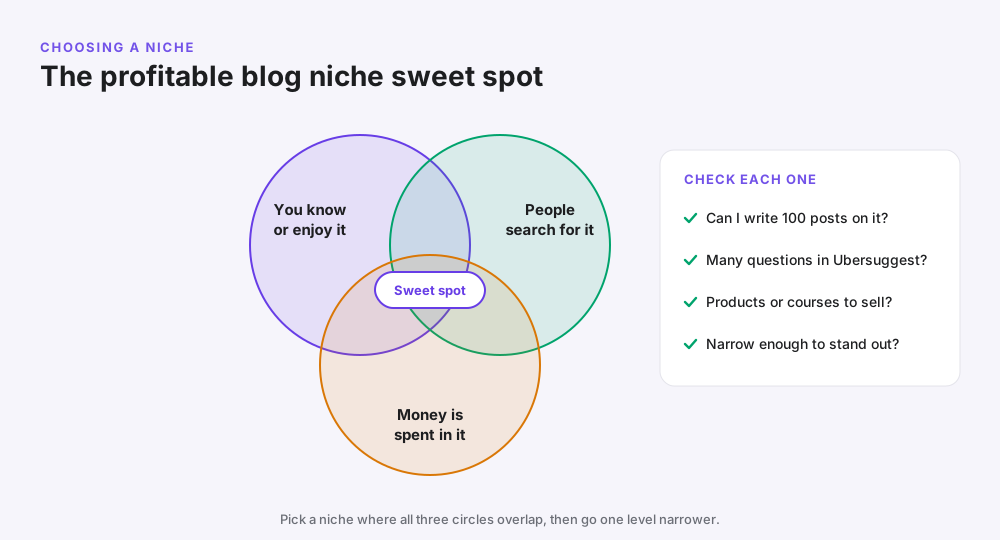
- You know or enjoy it. You will write 100+ posts, so you need real interest or experience.
- People search for it. Check keywords in a tool such as Ubersuggest; look for many questions with search volume.
- Money is spent in it. There should be products, courses or services that readers buy.
Blog niche ideas that make money
| Niche | Example topics | Main income | Competition |
|---|---|---|---|
| Personal finance | Credit cards, mutual funds, tax saving | Affiliate, ads | High |
| Tech and software | App reviews, tutorials, tools | Affiliate, ads | Medium |
| Health and fitness | Home workouts, diet plans | Products, coaching | High |
| Education and careers | Exams, courses, study tips | Affiliate, courses | Medium |
| Food and recipes | Regional recipes, kitchen tools | Ads, affiliate | Medium |
| Travel | Itineraries, budget trips | Affiliate (hotels), ads | High |
| Parenting | Baby products, school tips | Affiliate, ads | Medium |
| Local business guides | City guides, services | Sponsored, leads | Low |
Pro tip: go one level narrower than you think. Instead of “fitness”, try “home workouts for busy women over 30”. A narrower niche is easier to rank for and builds trust faster.
Common mistake: picking a niche only because it pays well. If you have no interest in insurance, you will stop writing about it by month three.
Step 2: Pick the best blogging platform to make money
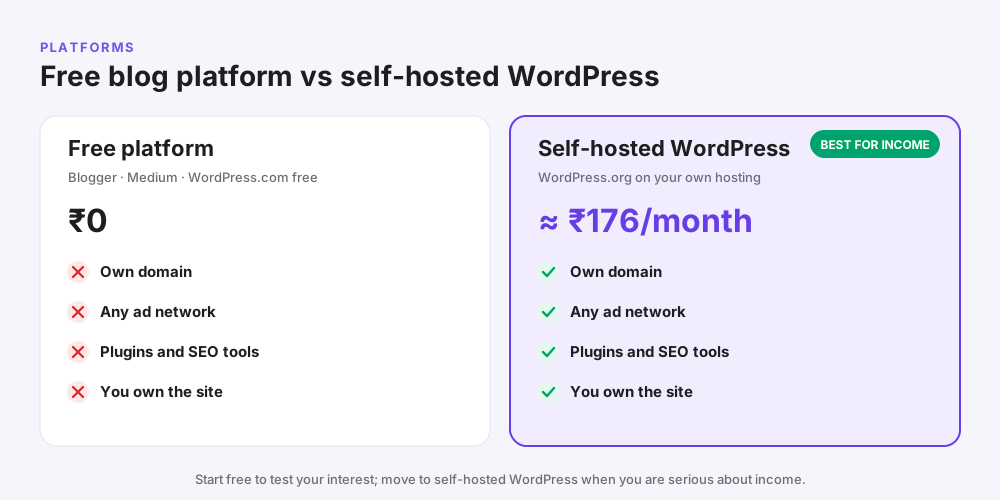
You can start a blog for free on Blogger, WordPress.com or Medium, or pay a small amount for a self-hosted WordPress blog (WordPress.org). If your goal is income, self-hosted WordPress is the clear choice.
| Feature | Free platforms (Blogger, Medium, WordPress.com free) | Self-hosted WordPress |
|---|---|---|
| Cost | ₹0 | ≈ ₹176/month (hosting + free first-year domain) |
| Own domain | Limited or extra cost | Yes |
| Full control of ads | Limited | Yes, any ad network |
| Affiliate links | Allowed with limits | Yes |
| Plugins and SEO tools | No or limited | Thousands of plugins |
| Who owns the site | The platform | You |
| Best for | Hobby writing, testing | Blogs you want to earn from |
When a free platform makes sense: you want to test whether you enjoy writing before spending money. Write 10 posts on Blogger or Medium first; if you are still enjoying it, move to WordPress. When it doesn’t: you are serious about income, because migrating later costs time and rankings.
Step 3: Get a domain name and web hosting
A domain is your blog’s address (for example, yourblog.com). Web hosting is the server where your blog’s files live. You need both, and many hosts include a free domain for the first year.
How to choose a good blog name
- Short, easy to say and spell (under 15 characters if possible)
- A .com for a global audience, or .in if your readers are mostly in India
- Avoid hyphens, numbers and trademarked brand names
- Leave room to grow: “HomeWorkoutLab” beats “10MinuteAbsWorkout”
Which hosting should a new blogger buy?
For a new blog, cheap shared hosting is enough. We recommend Hostinger Premium because it is easy for beginners, has a data centre in India, and includes a free domain, SSL and email for the first year. Read our full guide to the best web hosting for beginners or compare options in our best hosting in India roundup.
How much does it cost to start a blog in India?
| Item | Free route | Recommended route |
|---|---|---|
| Domain name | ₹0 (blogspot.com subdomain) | ₹0 in year 1 with Hostinger Premium, then ≈ ₹900–₹1,200/year |
| Hosting | ₹0 | ₹149/month on a 48-month term (₹7,152) + 18% GST |
| Theme | Free theme | Free theme (GeneratePress, Astra, Kadence) |
| Plugins | Not available | Free versions are enough |
| Email tool | — | Free plan (up to ~1,000 subscribers) |
| Total | ₹0 | ≈ ₹8,439 for 4 years (≈ ₹176/month) |
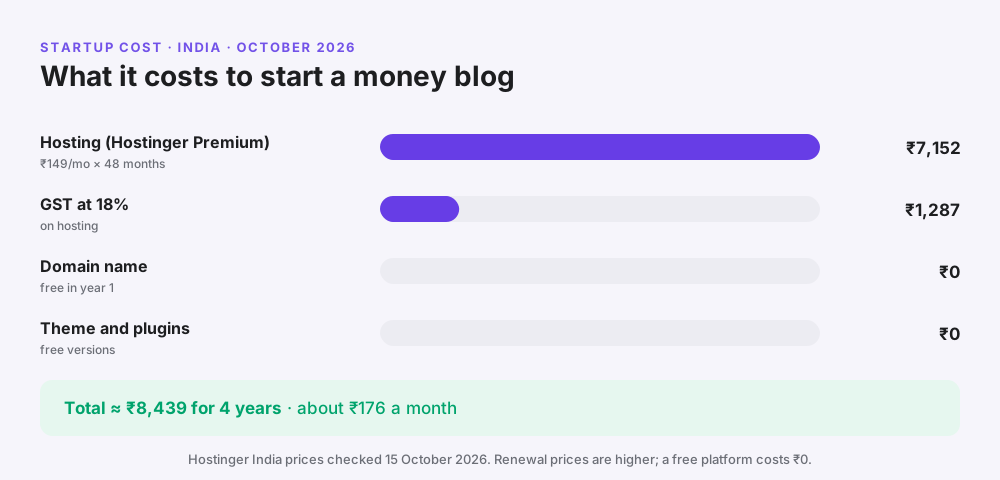
Pro tip: pay for the longer term at the start. Intro prices apply to the whole term you buy, and renewal is about three times higher. Check our Hostinger coupon page for the current deal.
Step 4: Set up your WordPress blog
Installing WordPress takes about 20 minutes with a one-click installer. Our step-by-step guide on how to create a WordPress website covers every screen; here is the short version.
- Buy hosting and claim your domain. Choose the Premium plan, a 48-month term, and claim your free domain in hPanel.
- Install WordPress. Use the one-click installer and pick the India server if your readers are in India.
- Choose a lightweight theme. GeneratePress, Astra or Kadence load fast and are free.
- Install a few essential plugins. An SEO plugin (All in One SEO, Yoast or Rank Math), a caching plugin (LiteSpeed Cache), an anti-spam plugin and a form plugin.
- Create your core pages. About, Contact, Privacy Policy, Disclaimer and Affiliate Disclosure. AdSense and affiliate programmes expect these.
- Set up tracking. Connect Google Search Console and Google Analytics so you can see which posts bring visitors.
- Add an email sign-up form. Place it in your sidebar and at the end of every post.
Common mistake: spending weeks on the design. Readers come for answers, not colours. Pick a clean theme, add your logo, and start writing.

Step 5: Write blog posts people actually search for
This is the step that decides whether your blog makes money. A post earns only if people find it, and most people find posts through Google. So every post should answer a question people already search for.
Find low-competition keywords
A keyword is the phrase someone types into Google. New blogs can’t compete for big keywords like “how to start a blog”, which has a very high difficulty score. Instead, target longer, specific phrases with low SEO difficulty (under about 20 in Ubersuggest).
| Keyword type | Example | Difficulty | Good for a new blog? |
|---|---|---|---|
| Broad (head) | how to start a blog | Very high | No |
| Medium | how to make money blogging | Low–medium | Yes, after a few months |
| Long-tail | how to start a blog in India for free | Low | Yes, start here |
| Question | how much do bloggers make in India | Low | Yes, great for FAQs |
Our guide on how to do SEO of your website explains keyword research and on-page SEO step by step.
The 4 types of posts every money blog needs
| Post type | Example | Purpose |
|---|---|---|
| How-to guides | How to make cold coffee at home | Bring in search traffic |
| “Best” lists | Best budget blenders under ₹3,000 | Earn affiliate commissions |
| Reviews and comparisons | Philips vs Bajaj blender | Capture buyers ready to purchase |
| Pillar guides | The complete guide to home coffee | Build authority and internal links |
How to structure a post that ranks

- Answer first. Give the short answer in the first 2–3 lines.
- Use clear H2 and H3 headings that match what people search for.
- Keep paragraphs short: 2–3 sentences, easy for mobile readers.
- Add proof: your photos, test results, prices, screenshots.
- Use tables and lists for comparisons and steps.
- Link to related posts on your blog, and to trusted sources.
- End with an FAQ that answers related questions.
Pro tip: write with experience. “I tested five blenders for a month” beats “Here are the top five blenders”. Google’s helpful content guidance rewards first-hand experience and original information.
Can you use AI to write blog posts? AI tools are useful for outlines, ideas and editing, but posts that are pure AI text rarely rank or earn trust. Add your own experience, examples and opinions to every post.
How often should you publish?
Aim for 2–3 quality posts a week for the first six months. That gets you to 50–75 posts, which is roughly when many new blogs start to see steady Google traffic. One great post a week is better than five thin ones.
Step 6: Get your first visitors
Google traffic takes time to arrive on a new blog, often 3–6 months. Use these channels to get readers while you wait.
| Traffic source | Speed | Effort | Best for |
|---|---|---|---|
| Google search (SEO) | Slow (3–12 months) | Medium | Long-term free traffic |
| Medium | Medium | Food, travel, DIY, home, fashion | |
| YouTube | Medium | High | Tutorials and reviews |
| Facebook groups and communities | Fast | Low | Local and hobby niches |
| Quora and Reddit | Fast | Low | Answering niche questions |
| Email newsletter | Builds over time | Low | Repeat visitors |
| Paid ads (Meta) | Instant | Costs money | Testing a product or lead magnet |
Best practice: share each new post in one or two places where your readers already hang out, and answer questions without spamming links. When you have a product or lead magnet, small paid campaigns can speed things up; our Meta ads beginners guide shows how.
Common mistake: chasing social media likes instead of search traffic. A post that ranks on Google can bring visitors every day for years without extra work.
Step 7: Start making money from your blog
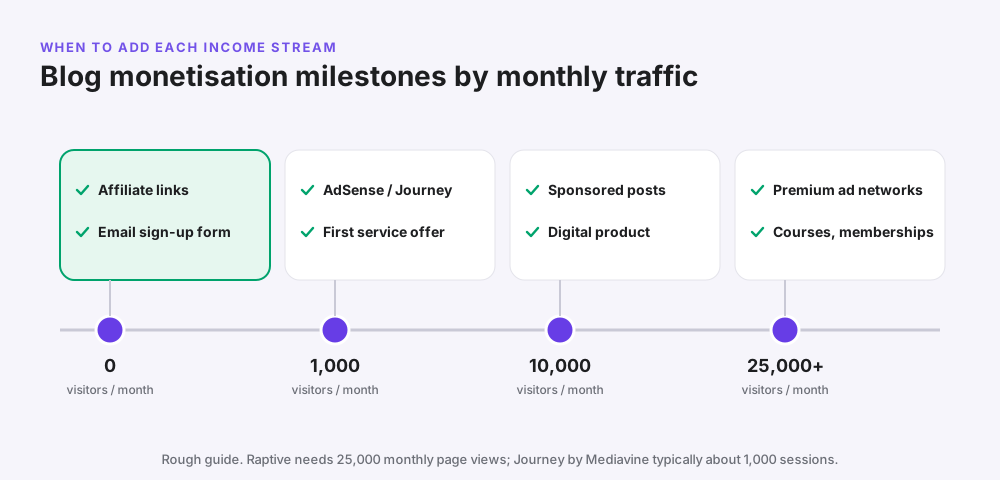
Add income streams in the right order. Starting with ads on a tiny blog earns almost nothing and slows your pages; starting with affiliate links and an email list earns earlier.
| Stage | Monthly visitors (rough) | What to add |
|---|---|---|
| Launch | 0–1,000 | Affiliate links in helpful posts, email sign-up form |
| Early growth | 1,000–10,000 | AdSense or Journey by Mediavine, first freelance or service offer |
| Growing | 10,000–25,000 | Sponsored posts, a small digital product |
| Established | 25,000+ | Premium ad networks (e.g. Raptive, if traffic mix qualifies), courses, memberships |
How to join affiliate programmes
- List the products you already use and recommend.
- Search “[brand] affiliate programme” or check networks such as Amazon Associates, Impact, CJ and Cuelinks.
- Apply once you have 10–15 quality posts and the required pages (About, Contact, Privacy).
- Add links naturally inside helpful posts, and add a disclosure near the top.
How to get approved for Google AdSense
- Publish original, useful posts (many bloggers apply after 20–30 posts)
- Have About, Contact, Privacy Policy and Disclaimer pages
- Use your own domain and a clean, easy-to-navigate design
- Follow the AdSense programme policies: no copied content or prohibited topics
How much money can you make blogging? (Real maths)
Blog income depends on traffic, niche and audience location. Here is a simple worked example for an Indian blog with 20,000 page views a month. These are illustrative assumptions, not guaranteed results.
| Income stream | Assumption | Monthly estimate |
|---|---|---|
| Display ads | 20,000 views × ₹100 RPM ÷ 1,000 | ≈ ₹2,000 |
| Affiliate | 1% click a product link (200 clicks) × 4% buy (8 sales) × ₹800 commission | ≈ ₹6,400 |
| Sponsored post | 1 small sponsored post a month | ≈ ₹3,000–₹5,000 |
| Total | ≈ ₹11,000–₹13,000/month |
Takeaway: affiliate income usually beats ads at this size. Doubling the traffic or targeting a higher-paying niche such as finance or software can multiply these numbers; an Indian audience on ads alone usually earns less than a US one.
How long does it take to make money blogging?
| Time from launch | What usually happens |
|---|---|
| Months 1–3 | 20–30 posts published; little Google traffic yet |
| Months 4–6 | First visitors from Google; first affiliate sale or AdSense earnings |
| Months 7–12 | Traffic grows if you keep publishing; ₹1,000–₹10,000/month is common for consistent blogs |
| Months 12–24 | Strong blogs reach a steady side income; some replace a salary |
Typical ranges for consistent bloggers, not guarantees. Many blogs earn less, and a few earn much more.
Mini case studies
These are illustrative scenarios based on common blogging paths, not specific people.
A food blogger in Punjab
Approach: 3 recipe posts a week on regional Punjabi dishes, with step photos, plus Pinterest pins. Income: display ads and affiliate links to kitchen tools. Lesson: visual niches grow faster with Pinterest alongside Google.
A software reviewer
Approach: honest reviews and comparisons of tools for freelancers, each with screenshots from real use. Income: software affiliate programmes paying per sign-up. Lesson: fewer visitors can still earn well when posts target buyers.
A fitness coach
Approach: blog posts answering home-workout questions, each ending with a free 7-day plan in exchange for an email. Income: online coaching sold to the email list. Lesson: a blog plus services can earn from the very first month.
Your first 90 days: a simple plan
| Period | Focus | Goal |
|---|---|---|
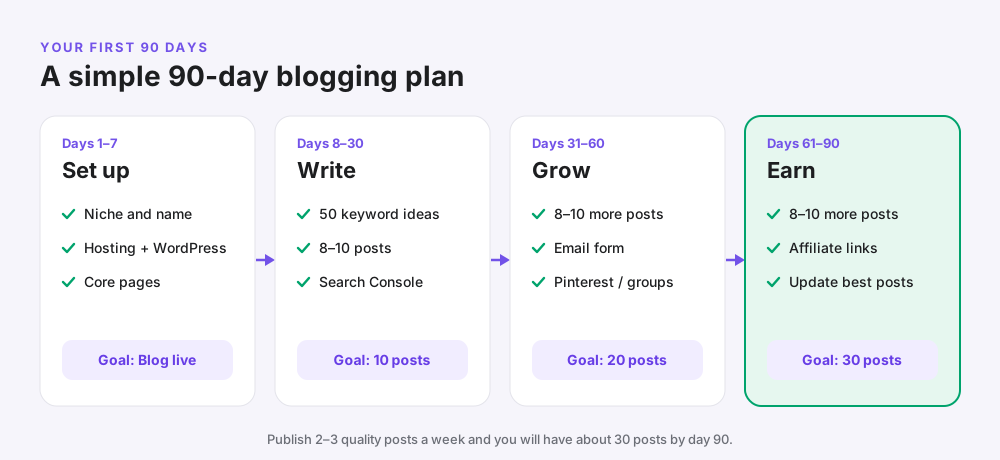
| Days 1–7 | Niche, name, hosting, WordPress setup, core pages | Blog live |
| Days 8–30 | Keyword list of 50 ideas; publish 8–10 posts | 10 posts live |
| Days 31–60 | Publish 8–10 more posts; set up email form and Pinterest/Facebook | 20 posts, first subscribers |
| Days 61–90 | Publish 8–10 more; apply to affiliate programmes; update best posts | 30 posts, first affiliate links |
Beginner blogging checklist
- ☐ Niche chosen with search demand and buyers
- ☐ Domain and hosting bought on a long term
- ☐ WordPress, theme and essential plugins installed
- ☐ About, Contact, Privacy, Disclaimer and Disclosure pages
- ☐ Google Search Console and Analytics connected
- ☐ 50 low-competition keywords in a spreadsheet
- ☐ Email sign-up form live
- ☐ Publishing schedule you can keep for 12 months
Common blogging mistakes that stop you making money
- Writing about random topics. Stick to one niche so Google and readers see you as an expert.
- Targeting keywords that are too competitive. Start with long-tail questions.
- Quitting at month three. Most blogs see little traffic before month four to six.
- Adding ads too early. They slow the site and earn pennies at low traffic.
- Ignoring email. Your list is the one audience you own.
- Copying or spinning content. It won’t rank and can get you banned from AdSense.
- Never updating old posts. Refreshing your top 10 posts every few months keeps them ranking.
- Choosing a free platform for a money blog. Moving later costs time and traffic.
Pro tips from experienced bloggers
- Write the post you wish you had found. Better than the current top result, not just longer.
- Use your own images where possible; compress them to WebP under 150 KB. An AI image generator helps with simple graphics.
- Interlink every new post with 2–3 older ones.
- Track income per post. Write more of what earns.
- Treat it like a business: fixed writing hours, a content calendar and a monthly review.
Frequently asked questions
Can I start a blog and make money for free?
Yes, you can start for free on Blogger or Medium and earn with affiliate links. For serious income, a self-hosted WordPress blog (about ₹176 a month with Hostinger Premium) gives you full control over ads and monetisation.
How much do bloggers make in India?
It varies widely. Many new bloggers earn nothing in the first few months; consistent bloggers commonly earn ₹1,000–₹10,000 a month within a year, and established blogs can earn a full-time income.
Does blogging still earn money in 2026?
Yes. Blogs that share real experience, comparisons and step-by-step help still earn through affiliate links, ads, email and products, even with AI answers in Google.
How long does it take to make money blogging?
Most beginners earn their first income in 3–6 months and a steady income after 12–18 months of publishing consistently.
How many blog posts do I need before making money?
You can add affiliate links from your first post, but most blogs see steady traffic and income after about 30–50 quality posts.
How many visitors do I need to make money blogging?
You can earn affiliate commissions with a few hundred visitors a month. Ad income becomes meaningful from around 10,000 monthly page views, and premium networks such as Raptive need at least 25,000.
Which blogging platform is best for making money?
Self-hosted WordPress (WordPress.org) is best, because you own the site and can use any ad network, affiliate programme or plugin.
How do bloggers get paid?
Bloggers are paid by ad networks (for example, AdSense pays once your balance reaches $100), by affiliate programmes via bank transfer, and directly by brands, clients and customers.
Is Google AdSense good for new blogs?
AdSense is easy to join but pays little at low traffic, especially for Indian audiences. Most new bloggers earn more from affiliate links first, then add AdSense later.
What is the best niche to start a blog and make money?
The best niche combines your knowledge, steady search demand and products people buy. Personal finance, tech, education, health and food are popular, but a narrow sub-niche is easier to rank in.
Can I make money blogging without writing?
Partly. You can hire writers or use AI for drafts, but posts need your experience and editing to rank. Video and podcast creators can also turn transcripts into blog posts.
Do I need to show my face or name to blog?
No. Many blogs are run under a brand name. Adding an author bio with real experience does help build trust with readers and Google.
Can I start a blog on my mobile?
Yes. You can buy hosting and write posts in the WordPress mobile app, though setting up the theme and plugins is easier on a laptop.
Do I need to pay tax on blogging income in India?
Yes. Blogging income is taxable as business or professional income in India. Speak to a chartered accountant about ITR, GST and claiming expenses.
Is affiliate marketing better than AdSense for a blog?
For most new blogs, yes. Affiliate commissions need much less traffic, while AdSense pays per thousand views and needs high traffic to earn well.
Related reading
- How to create a WordPress website (step by step)
- Best web hosting for beginners
- Best hosting in India 2026
- How to do SEO of your website
- Hostinger coupon code and current prices
Conclusion: start your blog this week
Learning how to start a blog and make money is simple; doing it consistently is the hard part. Pick a focused niche, set up a self-hosted WordPress blog, publish helpful posts that target low-competition keywords, and add affiliate links and an email list before ads.
Expect slow months at the start and real progress after six to twelve months of steady publishing. If you are ready, get Hostinger Premium for about ₹176 a month, install WordPress today, and write your first post this week.