
Quick answer
Facebook ads for small business work best when you keep things simple: one clear goal, a small daily budget, a local audience, three honest ads with a real offer, and a fast way for people to contact you. Most small businesses can start with about ₹300–₹700 a day in India or $15–$40 a day in the US, then judge results after two to three weeks.
Skip boosting random posts. Use Ads Manager, track leads or sales, reply to every enquiry within minutes, and keep the ads that bring customers at a cost you can afford.
Facebook ads for small business at a glance (2026)
- Best goals to start with
- Leads, Messages (WhatsApp) or Sales
- Starting budget (India)
- ₹300–₹700 a day
- Starting budget (US)
- $15–$40 a day
- Targeting
- Local radius + broad / Advantage+
- Ads to launch with
- 3 versions, one offer
- Time to judge results
- 2–3 weeks, not 2 days
In this playbook:
- Quick answer
- Are Facebook ads worth it for a small business?
- Step 1: Set up your accounts properly
- Step 2: Pick one goal
- Step 3: Set a realistic budget
- Step 4: Target the right people
- Step 5: Make ads people stop for
- Step 6: Choose where people land
- Step 7: Launch your first campaign
- Step 8: Measure and improve
- Your first 30 days
- Small business examples
- Common mistakes
- DIY, freelancer or agency?
- FAQs
You have a good product, happy customers and a Facebook page that hardly anyone sees. You boosted a post once, spent ₹2,000, got 40 likes and zero customers. Sound familiar?
That is the most common story we hear from small business owners. The problem is rarely Facebook itself. It is usually the wrong goal, the wrong audience or an ad that gives people no reason to act.
This beginner’s playbook fixes that. You will learn how to run Facebook ads for small business step by step: the setup, the budget, the targeting, the creative and a 30-day plan you can follow even if you have never opened Ads Manager. It works for shops and services in India and the US.

Are Facebook ads worth it for a small business?
Yes, for most small businesses with a clear offer and a way to handle enquiries. Facebook and Instagram let you show ads to people in your exact area, at a budget you control, and pay only for the results you choose to optimise for.
They are not a magic switch, though. Ads amplify what you already have. A great offer gets better; a weak offer just gets expensive.
| Facebook ads are a good fit if… | Think twice if… |
|---|---|
| You sell to local customers or ship across the country | You have no clear price, offer or product yet |
| A customer is worth at least a few thousand rupees (or $50+) to you | Your margin per sale is tiny and repeat sales are rare |
| You can reply to leads or WhatsApp messages quickly | Nobody will answer enquiries for hours or days |
| You have photos or videos of your real product or service | You can only use generic stock images |
| You can spend for at least 3–4 weeks to learn | You want sales by tomorrow on a ₹500 test |
Why small businesses use Facebook ads
- Local reach. Target a 5 km radius around your shop or the cities you serve.
- Low starting cost. You can begin with a few hundred rupees or dollars a day and stop anytime.
- Two platforms in one. One campaign can run on Facebook, Instagram, Messenger and WhatsApp.
- Fast feedback. You learn within days which offers and messages your customers respond to.
- Direct conversations. Click-to-WhatsApp and lead forms put customers in touch with you without a website.
Facebook ads vs Google ads: Google shows ads to people already searching for you. Facebook shows ads to people who match your customer but are not searching yet. Many small businesses use Google for “emergency” searches (plumber near me) and Facebook for offers, new products and repeat customers.
Step 1: Set up your accounts properly
Ten minutes of setup now saves weeks of problems later. Everything lives inside a free Meta business portfolio (the new name for Business Manager), which you own.
- Create a business portfolio in Meta Business Suite using your own Facebook profile.
- Add your Facebook Page and Instagram account to the portfolio.
- Create an ad account in your business name, with your correct currency and time zone. These can’t be changed later.
- Add a payment method: card or UPI in India, card or PayPal in the US.
- Set up tracking. If you have a website, install the Meta Pixel and turn on the Conversions API. If you don’t, connect WhatsApp Business to your Page.
- Verify your business when Meta asks. It improves trust and helps if your account is ever reviewed.
Best practice: never run ads from a freelancer’s or agency’s own ad account. If you hire help later, give them partner access to your portfolio so you keep your data, audiences and ad history.
Common mistake: choosing the wrong currency. An Indian business that sets up in US dollars pays card conversion charges on every bill.
Step 2: Pick one goal for your first campaign
A campaign objective tells Meta what result to look for. If you choose Traffic, Meta finds people who click. If you choose Leads, it finds people who fill forms. So pick the objective that matches the result you actually want.
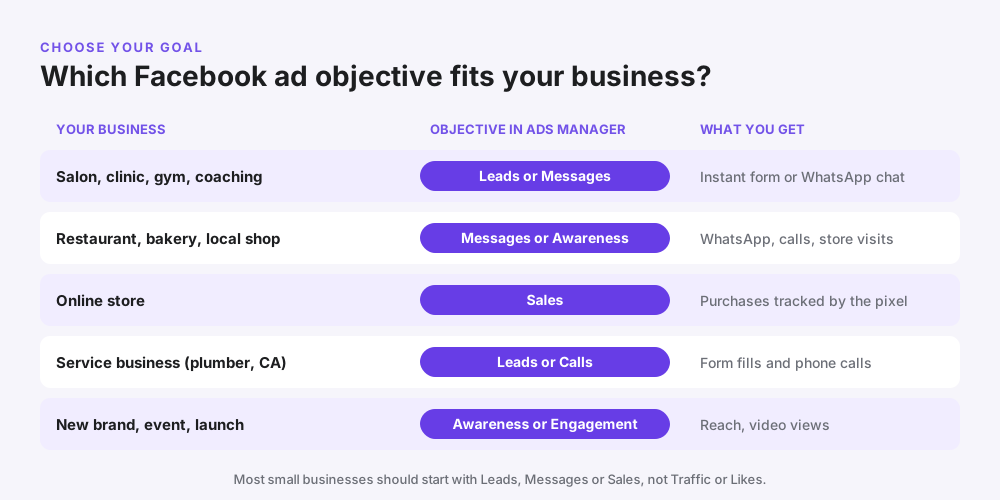
| Objective | What Meta optimises for | Best for | Avoid when |
|---|---|---|---|
| Leads | Form fills or calls | Clinics, coaching, real estate, services | You can’t follow up quickly |
| Engagement → Messages | WhatsApp or Messenger chats | Local shops, salons, bakeries, boutiques | You don’t check WhatsApp often |
| Sales | Purchases on your website | Online stores with a pixel | Your pixel isn’t tracking purchases |
| Traffic | Clicks to a page | Content and blogs | You need leads or sales (usually) |
| Awareness | Reach and recall | Launches, events, new locations | You need results this month |
Pro tip: for most small businesses, the first campaign should be Leads or Messages. These give cheaper, faster results than Sales, so Meta learns quicker on a small budget.
Boost post vs Ads Manager
| Boost post | Ads Manager | |
|---|---|---|
| Setup time | 1 minute | 10–15 minutes |
| Goals available | Mostly engagement and messages | All objectives, including leads and sales |
| Targeting | Basic | Full: locations, custom audiences, lookalikes |
| Testing | One post at a time | Several ads, A/B tests |
| Best for | Quick reach for a good post | Getting customers |
Boosting is fine for spreading a popular post. For customers, use Ads Manager.
Step 3: Set a realistic Facebook ads budget
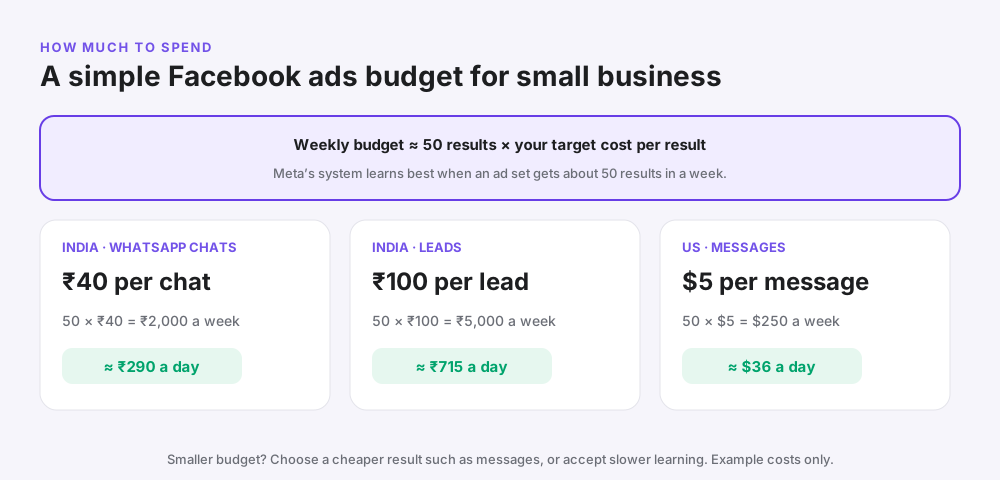
How much should a small business spend on Facebook ads? Enough for Meta to learn. Meta’s system exits its learning phase after an ad set gets about 50 results in a week, so your budget should match the cost of the result you choose.
| Business type | Typical first goal | Starting daily budget (India) | Starting daily budget (US) |
|---|---|---|---|
| Salon, gym, clinic | Messages or leads | ₹400–₹800 | $20–$40 |
| Local shop, bakery, restaurant | Messages | ₹300–₹600 | $15–$30 |
| Service business | Leads | ₹500–₹1,000 | $25–$50 |
| Online store | Sales | ₹700–₹1,500 | $30–$60 |
| Coaching or education | Leads | ₹600–₹1,200 | $25–$50 |
A simple budget formula
Weekly budget ≈ 50 × your target cost per result. If a WhatsApp enquiry costs around ₹40, that is ₹2,000 a week, or about ₹290 a day. If a lead costs $15, that is $750 a week.
If that number is too high, don’t give up. Pick a cheaper result (messages instead of sales), run one ad set instead of three, and accept that learning will take longer.
Common mistake: splitting ₹500 a day across five ad sets. Each one gets ₹100 and none of them learns. Start with one campaign and one ad set.
For detailed budget plans, see our guide on how much Facebook ads cost in India.
Step 4: Target the right people
Targeting tells Meta who is allowed to see your ads. In 2026, Meta’s Advantage+ audience usually finds buyers better than long lists of interests, especially when your ad itself is clear about who it is for.
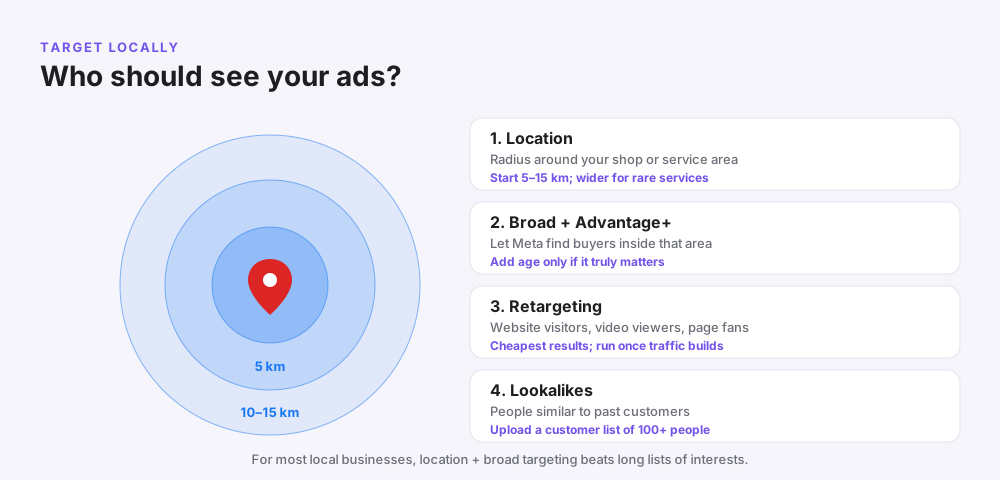
The 4 targeting layers for a small business
- Location: a radius around your shop (5–15 km) or the cities you deliver to. Choose “people living in or recently in this location”.
- Broad or Advantage+ audience: let Meta find buyers inside that area. Add an age range only if it truly matters, such as 18+ for a gym.
- Retargeting: people who visited your website, watched your videos or messaged your Page. These are usually your cheapest customers.
- Lookalikes: people similar to your existing customers. Upload a customer list (phone numbers or emails) of at least 100 people.
When not to go broad: if you sell something very specific, such as B2B software or wedding photography, add one or two strong interests or job titles to guide Meta.
Pro tip: your ad is your targeting. An ad that says “For new mums in Mohali” attracts new mums in Mohali, even with broad settings.
Step 5: Make ads people actually stop for
Creative is now the biggest lever in Facebook ads. The image or video, the first line of text and the offer decide who stops scrolling, and Meta uses that response to find more people like them.

Launch with 3 ads
| Ad | Format | Idea |
|---|---|---|
| Ad 1 | Short vertical video (Reel, 9:16) | You or your team showing the product or service, 10–20 seconds |
| Ad 2 | Square photo (1:1) | Your best real product photo with the offer in the first line |
| Ad 3 | Customer proof | A review, testimonial or before/after, with permission |
A simple ad copy template
- Hook: name the customer or the problem. “Tired of waiting a week for a plumber in Zirakpur?”
- Value: one or two lines on what you offer and why you’re different.
- Offer: a reason to act now: a discount, a free consultation, a free delivery slot.
- Proof: “Rated 4.8 by 300+ customers” or “Serving Chandigarh since 2015”.
- Call to action: one clear next step: “Tap WhatsApp to book.”
Best practices: use real photos, add captions to videos (most people watch without sound), keep important text inside the safe zone, and refresh your ads every few weeks. Browse the Meta Ad Library to see what other businesses in your category are running.
Common mistake: an ad that only says “We are the best salon in town”. Every salon says that. Show a result, a price or an offer instead.
Step 6: Choose where people land
You don’t need a website to run Facebook ads. Choose the destination that makes it easiest for your customer to say yes.
| Destination | How it works | Best for | Watch out for |
|---|---|---|---|
| WhatsApp chat | Ad opens a chat with your business | Local shops, salons, services in India | Slow replies lose customers |
| Instant form | Form opens inside Facebook, pre-filled | Clinics, coaching, real estate | Low-quality leads if too easy |
| Phone call | Ad button calls you directly | Urgent services: repairs, towing | Missed calls during busy hours |
| Website or landing page | Visitor goes to your site | Online stores, detailed services | Slow or confusing pages |
Pro tip: add one or two qualifying questions to lead forms, such as “When do you want to start?” This lowers the number of leads slightly but raises the quality a lot.
Not sure between WhatsApp and forms? Read our comparison of click-to-WhatsApp ads vs lead forms. If you do send people to a website, make sure it loads fast; our guide to WordPress hosting vs web hosting covers the basics.
Step 7: Launch your first campaign in Ads Manager
- Open Ads Manager and click Create.
- Choose your objective: Leads, Engagement (for messages) or Sales.
- Name the campaign clearly, for example “Leads | Mohali | Oct 2026”.
- At the ad set level, pick the conversion location (instant form, WhatsApp, website or calls).
- Set your daily budget and a start date. Leave the end date empty if you want it to run until you stop it.
- Set location, then leave the audience broad with Advantage+ on.
- Keep Advantage+ placements on so Meta can show your ads across Facebook, Instagram and Reels.
- At the ad level, upload your 3 creatives, write your copy and choose one call-to-action button.
- Preview each placement, then publish. Meta usually reviews ads within a few hours.
After launch: leave the campaign alone for at least 4–5 days. Every big edit can restart the learning phase.
Step 8: Measure and improve
Judge your ads on cost per result, not likes. A post with 500 likes and no enquiries is worse than an ad with 10 likes and 20 bookings.
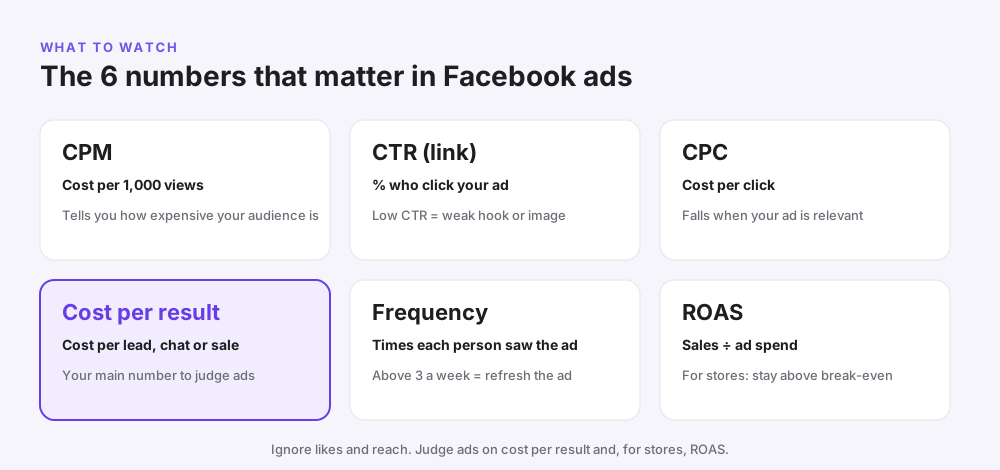
| Metric | What it tells you | What to do |
|---|---|---|
| Cost per result | What you pay for each lead, chat or sale | Your main number; compare it with what a customer is worth |
| CTR (link click-through rate) | How many people click | Low CTR usually means a weak hook or image |
| CPM | Cost to reach 1,000 people | High CPM can mean a small or competitive audience |
| Frequency | How often each person sees the ad | Refresh the creative when it climbs above about 3 in a week |
| ROAS (stores) | Sales value ÷ ad spend | Should stay above your break-even point |
| Lead to customer rate | How many enquiries become customers | Track this yourself in a sheet or CRM |
Work out your break-even cost per customer
If your average customer brings ₹3,000 profit, you can afford to pay up to ₹3,000 in ads to win one. If one in five leads becomes a customer, a lead is worth up to ₹600 to you. Anything below that is profitable.
How to scale: when an ad set is profitable for a week, raise its budget by about 20% every few days. Big jumps can restart learning. Once you have traffic, add a retargeting campaign for people who engaged but didn’t buy.
Your first 30 days: a week-by-week plan
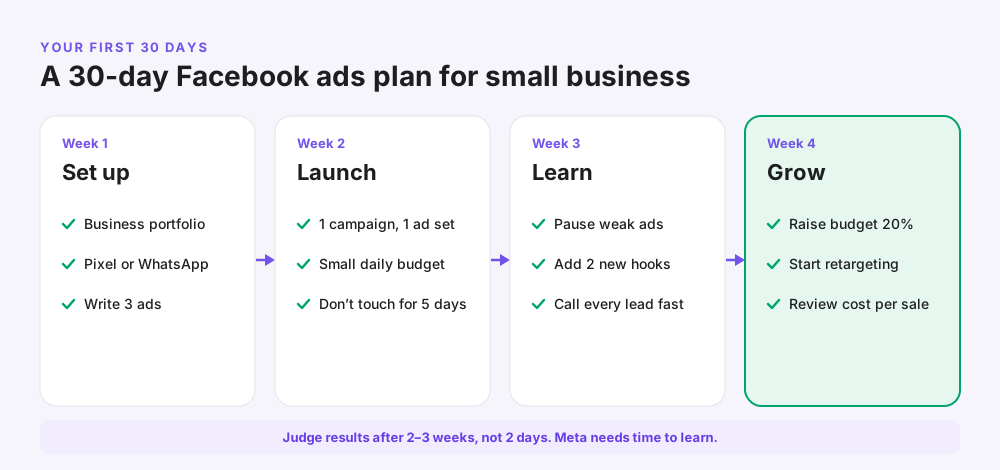
| Week | What to do | Goal |
|---|---|---|
| Week 1 | Set up portfolio, Page, ad account, pixel or WhatsApp; write 3 ads; prepare a lead sheet | Everything ready to launch |
| Week 2 | Launch 1 campaign with 1 ad set and 3 ads; reply to every lead within 15 minutes | First results |
| Week 3 | Pause the weakest ad; add 2 new versions of the best one; check lead quality | Lower cost per result |
| Week 4 | Raise the budget 20% if profitable; start retargeting; review cost per customer | A repeatable system |
Pro tip: write down what you change and when. After a month you will know exactly which offer, image and audience works for your business.
Small business examples: what this looks like in practice
These are illustrative scenarios based on common small business set-ups, not specific clients.
A bakery in Chandigarh
Setup: Messages objective, click-to-WhatsApp, 8 km radius, ₹400 a day. Ads: a Reel of a cake being decorated, a photo of the best seller with “Order by 4 pm for same-day delivery”, and a customer review. What works: quick WhatsApp replies with a price list and photos, which turn chats into orders the same day.
A dental clinic in Texas
Setup: Leads objective, instant form with one question (“Which treatment are you interested in?”), 15-mile radius, $30 a day. Ads: the dentist explaining a free check-up offer, and before/after photos with consent. What works: calling each lead within 10 minutes and offering two appointment times.
An online clothing boutique
Setup: Sales objective, pixel and Conversions API tracking purchases, all-India targeting, ₹1,000 a day. Ads: UGC-style try-on videos and a carousel of the new collection. What works: a retargeting campaign for people who added to cart, plus fresh creatives every two weeks. Our guide on structuring your first ₹50,000 of Meta ad spend goes deeper.
For more industry-specific plans, see Meta ads for gyms and salons and Facebook lead ads for coaching institutes.
Common Facebook ads mistakes small businesses make
- Boosting posts instead of using Ads Manager. You get likes, not customers.
- Choosing Traffic when you want leads. Meta will find clickers, not buyers.
- Spreading a small budget too thin. One ad set beats five tiny ones.
- Targeting too narrowly. Tiny audiences cost more and stop delivering quickly.
- Using stock photos. Real photos of your shop, team and products build trust.
- No offer. Give people a reason to act today.
- Slow follow-up. A lead called after two days is usually a lost lead.
- Editing every day. Constant changes keep resetting the learning phase.
- Judging after 48 hours. Give a campaign 2–3 weeks before deciding.
- Not tracking customers. Without a lead sheet, you can’t tell good ads from bad ones.
Should you run Facebook ads yourself, or hire help?
| Option | Monthly cost | Best for | Trade-off |
|---|---|---|---|
| Do it yourself | Your time | Budgets under about ₹15,000 ($300) a month; learning the basics | Slower learning, trial and error |
| Freelancer | ₹5,000–₹25,000 in India | Simple campaigns, small budgets | Depends on one person’s skills |
| Agency | From about ₹10,000–₹15,000 in India | Budgets above ₹30,000 a month, growth focus | Monthly fee on top of ad spend |
Many owners start on their own with this playbook, then hire help once ads become a main source of customers. If you want to learn the platform in more depth first, read our Meta Ads for beginners guide. To see what an agency actually does day to day, read what a Meta Ads agency does.
Free learning: Meta’s own Blueprint courses and its small business advertising guide are worth an afternoon.
Frequently asked questions
Are Facebook ads worth it for a small business?
Yes, for most small businesses with a clear offer and a fast way to handle enquiries. They let you reach local customers with a small, controllable budget. They work poorly when there is no clear offer or nobody follows up on leads.
How much should a small business spend on Facebook ads?
Most small businesses can start with about ₹300–₹700 a day in India or $15–$40 a day in the US. A useful rule is a weekly budget of roughly 50 times your target cost per result, so Meta has enough data to learn.
What is the minimum budget for Facebook ads in India?
Meta allows very small daily budgets, but in practice ₹300–₹500 a day is a sensible minimum for a small business test, plus GST. Smaller budgets can work for messages but learn slowly.
Do Facebook ads work for local businesses?
Yes. You can target a radius around your shop, and objectives like Messages, Calls and Leads suit local businesses such as salons, clinics, gyms, restaurants and home services.
Can I run Facebook ads without a website?
Yes. You can send people to WhatsApp, Messenger, an instant lead form inside Facebook, or a phone call. A website is mainly needed for online stores.
Is boosting a post the same as running Facebook ads?
No. Boosting is a quick, limited way to promote one post. Ads Manager gives you all objectives, including leads and sales, better targeting and proper testing.
Which Facebook ad objective is best for a small business?
Start with Leads or Messages for service and local businesses, and Sales for online stores with a working pixel. Avoid Traffic and Awareness when you need customers this month.
How long do Facebook ads take to work?
You may see first enquiries within a few days, but give a campaign two to three weeks to learn and stabilise before judging it. Meta’s learning phase needs about 50 results in a week.
How do I target local customers on Facebook?
Set a location radius around your business or the cities you serve, keep the audience broad with Advantage+, and make the ad itself mention your area. Add retargeting once you have website visitors or video viewers.
How many ads should I run at first?
Start with one campaign, one ad set and three ads: a short video, a strong photo with your offer, and customer proof. Then replace the weakest ad every week or two.
Are Facebook ads better than Google ads for small business?
They do different jobs. Google ads reach people already searching, while Facebook ads create demand among people who match your customer. Many small businesses use Google for urgent searches and Facebook for offers and repeat customers.
Can I run free Facebook ads?
Ads always cost money, but you can promote your business for free with regular posts, Reels, a complete Page, WhatsApp Business and Facebook groups. Paid ads simply speed up reach.
What should a small business Facebook ad say?
Name the customer or problem in the first line, explain your offer in one or two lines, add proof such as reviews, and end with one clear action like “Tap WhatsApp to book.”
How do I know if my Facebook ads are working?
Track cost per lead, chat or sale, and how many of those become paying customers. Compare that with how much profit a customer brings you. Likes and reach are not a good measure.
Should I hire an agency for Facebook ads?
It makes sense once you spend about ₹30,000 or more a month or ads become a main source of customers. With smaller budgets, learning the basics yourself or using a freelancer is usually better value.
Related reading
- Meta Ads for beginners: a complete guide
- How much Facebook ads cost in India
- Click-to-WhatsApp ads vs lead forms
- Meta ads for gyms and salons
- Facebook lead ads for coaching institutes
- What does a Meta Ads agency actually do?
Conclusion: start small, learn fast, grow what works
Facebook ads for small business don’t need big budgets or complicated funnels. They need one clear goal, a realistic budget, a local audience, honest ads with a real offer, and fast follow-up on every enquiry.
Follow the 30-day plan, judge your ads on cost per customer, and scale slowly what works. Within a month you will know far more about your customers than any boosted post could tell you.
Want a second pair of eyes before you spend? GetToMarketing is a Meta Ads agency in Zirakpur helping small businesses across Chandigarh, Mohali, Panchkula and India. Book a free discovery call and we will review your plan with you, with no obligation.
1 thought on “Facebook Ads for Small Business: A Beginner’s Playbook (2026)”